CellsAndCraft
How to Price Handmade Items: A Formula That Includes Fees
It is easy to look at similar listings, pick a price that feels safe and hope it works out. But a price chosen this way often leaves out something: your time, the packaging, the postage you pay for "free shipping", or the fees the platform takes from every sale. Each is small on its own. Together they decide whether a sale makes money.
This guide walks through a five-step pricing method for any handmade product, with one worked example from start to finish.
Step 1: Work out the material cost per item
Start with everything that goes into one finished item. For each material, divide what you paid by how many items it makes, or multiply the amount you use by the cost per unit.
Example: a pair of polymer clay earrings.
| Material | Used | Cost |
|---|---|---|
| Polymer clay | 30 g at $0.04 per g | $1.20 |
| Earring hooks | 1 pair | $0.35 |
| Jump rings | 2 at $0.05 | $0.10 |
| Gloss varnish | 1 coat | $0.12 |
| Materials | $1.77 |
Then add packaging: a card, a bag, a sticker, tissue paper. In the example that is $0.45 per item.
Two tips that save a lot of guessing later:
- Use what you actually paid, including shipping on your supply orders and any discount you got. If prices go up, update the number.
- Count small things once. Glue, thread and varnish feel free because one bottle lasts a long time. Estimate how many items one bottle covers and divide.
Step 2: Pay yourself for your time
This is the step most handmade prices skip, and it is the one that matters most. If your price does not include your time, then every sale pays for the materials and the platform, and you work for free.
Pick an hourly rate you would be content to earn. Then time how long one item really takes, from start to finish: making, finishing, packing. Time a few items, not just one.
Example: 25 minutes per pair of earrings at $20 an hour.
25 ÷ 60 × $20 = $8.33 labor per item
If that number makes your price look too high, do not drop the labor line. Keep it in, and look at the result in step 5 instead: it shows you what you really earn per hour at the price you choose.
Step 3: Add overhead
Overhead is what you pay for the business that is not part of one item: tools that wear out, your workspace, light, software. Exact numbers are hard, so a simple percentage on top of materials and packaging is a practical shortcut.
Example: 10% of materials and packaging = 10% × ($1.77 + $0.45) = $0.22
Step 4: Include postage and platform fees
Postage
If you offer free shipping, the postage you pay is a cost of the item. If you charge shipping, the buyer pays some or all of it, but fees are charged on that shipping too.
Example: you pay $4.10 postage and charge the buyer $4.50.
Your total cost per item is now:
$1.77 materials + $0.45 packaging + $8.33 labor + $0.22 overhead + $4.10 postage = $14.88 (rounded; labor is $8.333…)
Etsy fees
On Etsy, a standard sale has three fees (rates checked October 2026, see Etsy's fee page):
- Listing fee: $0.20 per item sold (the listing auto-renews after each sale).
- Transaction fee: 6.5% of the item price plus shipping.
- Payment processing: depends on the country of your bank account. For a US bank account it is 3% + $0.25 per order.
If a sale comes through Offsite Ads, Etsy adds a 15% fee (12% for shops above $10,000 in yearly sales, capped at $100 per order). Some countries also have a regulatory operating fee. Check the rates for your country before you price.
For a US shop that gives:
- Percentage fees: 6.5% + 3% = 9.5% of the price plus shipping
- Fixed fees: $0.20 + $0.25 = $0.45 per order
The important part: fees are a percentage of the price, so you cannot simply add them to your cost. If you add $1.50 for fees, the fees on the higher price are higher again. That is why the formula below divides instead of adds.
Step 5: Choose a margin and calculate the price
Profit margin is the share of the price you keep as profit after all costs, fees and your own pay. Your labor is already in the cost, so this profit is the business's money: for slow months, new tools, growth.
The formula:
Price = (total cost + fixed fees − shipping charged × (1 − fee %)) ÷ (1 − fee % − target margin)
Set the margin to 0% to get your break-even price: the lowest price that still pays your materials, overhead, postage, fees and your hourly rate.
Example, with a 30% target margin:
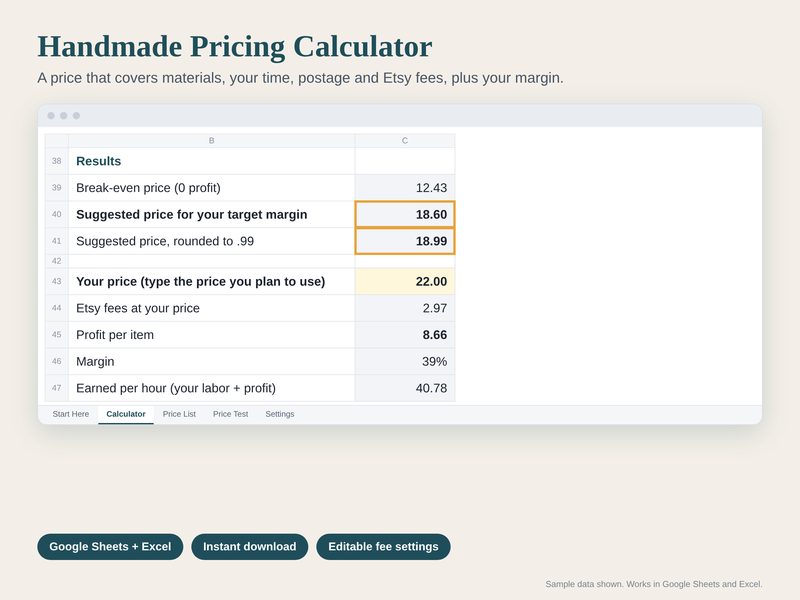
- Break-even price: ($14.88 + $0.45 − $4.50 × 0.905) ÷ 0.905 = $12.43
- Suggested price: ($14.88 + $0.45 − $4.50 × 0.905) ÷ (0.905 − 0.30) = $18.60, or $18.99 rounded
Then test the price you actually want to use. At $22.00 plus $4.50 shipping:
| Etsy fees: ($22.00 + $4.50) × 9.5% + $0.45 | $2.97 |
| Profit after all costs and your labor | $8.66 |
| Margin | 39% |
| Earned per hour (labor + profit) | $40.78 |
The last line is worth looking at for every product. It tells you what an hour of your work really earns at that price, after everything else is paid.
Sanity checks before you publish
- Compare with similar listings, but use them as a check, not as the starting point. If the market price is far below your break-even price, the answer may be a simpler design, a faster process or a different product, not a lower price.
- Watch cheap items. The fixed fees ($0.45 per order in the US example) weigh more on a $6 item than on a $40 one. Bundles and sets can help.
- Re-check when costs change. Supplier price rises, a postage increase or a fee change all move your break-even price.
- Time-heavy crafts need extra care. Crochet, knitting and embroidery often take hours per piece. Write down your hours honestly and look at "earned per hour". If you crochet, track hook time and finishing time (weaving in ends, sewing, blocking) separately, because finishing is easy to forget.
Try it with your own numbers
You can do all of this on paper, but it is quicker to let a calculator handle the fee math. Our free Etsy fee calculator shows every fee and your profit for any price you want to test. For a full breakdown of each fee, read Etsy fees in 2026: what you really keep from a sale.
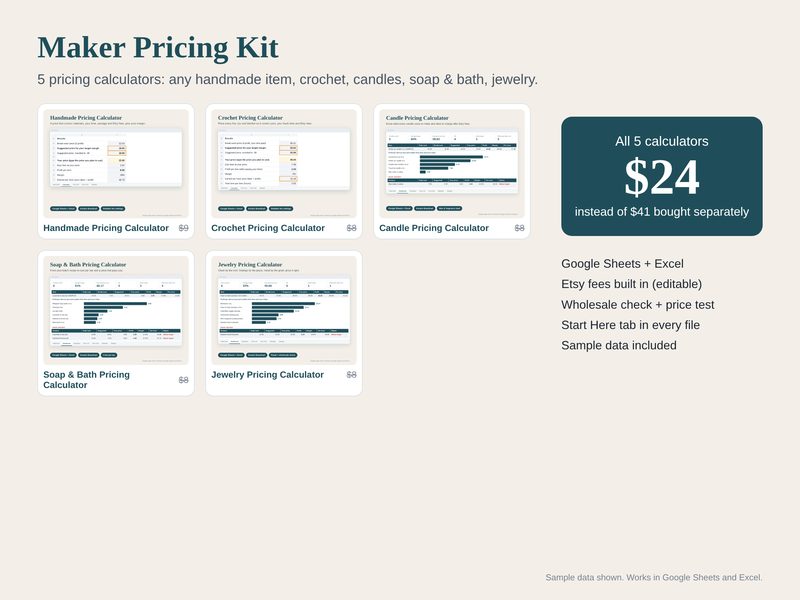
For the full method in this article, with every fee, postage, shipping you charge, a price test with six prices and a price list for up to 50 products, there is the Handmade Pricing Calculator spreadsheet. For crochet there is a version with yarn per skein, skeins to buy, pattern cost and hook hours (Crochet Pricing Calculator). Both work in Google Sheets and Excel. Making candles, soap, jewelry, resin, quilts, pottery or laser work? See all pricing calculators.
Example numbers are made up for illustration. Fee rates as listed on Etsy's fee pages, checked October 2026; fees change, so check the current rates for your country. Not affiliated with or endorsed by Etsy, Inc. This article is general information, not tax, legal or accounting advice. Written with the help of AI tools and checked by hand.